
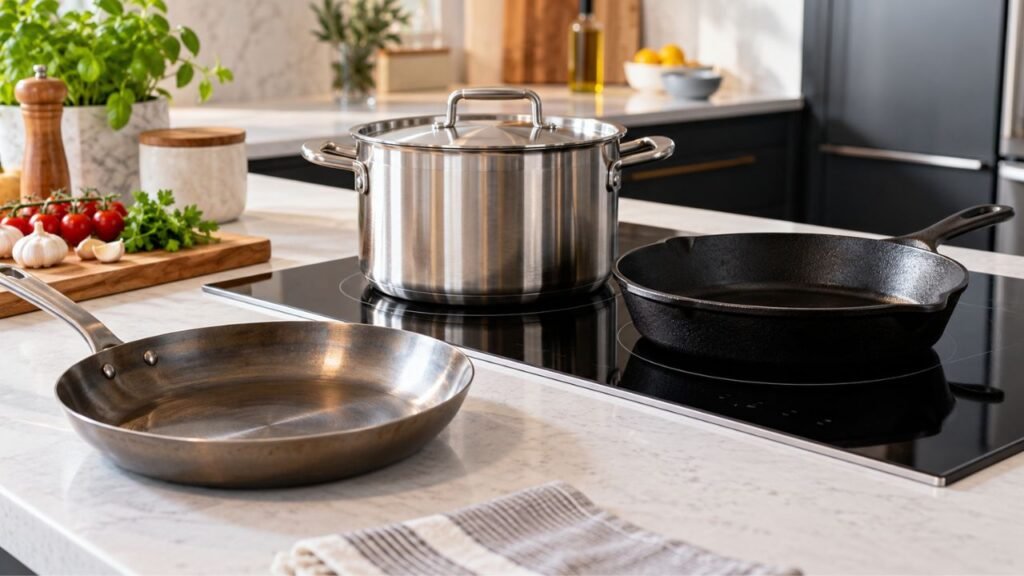
Cookware works on an induction cooktop when its bottom contains magnetic material. Cast iron, carbon steel, enameled steel, and magnetic stainless steel usually work well. Aluminum, copper, glass, and ceramic generally need a magnetic base.
In this guide, I’ll help you identify compatible cookware quickly. We’ll also cover materials, pan sizes, magnet testing, and common compatibility problems.
Key Takeaways
- Induction cooktops require cookware with a magnetic base.
- Cast iron and carbon steel naturally work with induction cooking.
- Stainless steel works only when its base is magnetic.
- Aluminum and copper require a bonded magnetic induction layer.
- Nonstick cookware may work depending on its base construction.
- A simple refrigerator magnet can test most cookware quickly.
- Flat, correctly sized cookware usually gives the best heating performance.
What Cookware Works on an Induction Cooktop? Quick Comparison
Several cookware materials can work with induction cooking. However, compatibility depends more on the bottom construction than appearance.
| Cookware Material | Works on Induction? | What to Check | Main Consideration |
| Cast iron | Yes | Flat, smooth base | Heavy but excellent heat retention |
| Enameled cast iron | Yes | Smooth bottom | Great for slow cooking |
| Carbon steel | Yes | Flat magnetic base | Fast heating and responsive |
| Stainless steel | Sometimes | Magnet sticks firmly | Not all stainless steel is magnetic |
| Enameled steel | Usually | Magnetic steel underneath | Lightweight and responsive |
| Nonstick | Sometimes | Induction-ready magnetic base | Coating alone does not matter |
| Ceramic-coated | Sometimes | Magnetic layer underneath | Depends on cookware construction |
| Aluminum | Usually no | Bonded magnetic plate | Plain aluminum will not work |
| Copper | Usually no | Magnetic steel base | Pure copper is not compatible |
| Glass | No | None | Nonmagnetic material |
| Solid ceramic | No | None | Normally not induction compatible |
If you are unsure about a pan, test its bottom first. That saves you from replacing cookware unnecessarily.
Why Does Induction Cookware Need to Be Magnetic?
An induction cooktop works differently from gas or standard electric burners. Instead of heating a burner first, it creates an electromagnetic field beneath the glass.
That magnetic field interacts with suitable cookware sitting above it. The cookware itself produces the heat used for cooking.
For this process to work, the pan needs enough magnetic material underneath.
That is why cookware color, coating, and price mean little. What really matters is the material inside the bottom.
A beautiful aluminum skillet may not heat at all. Meanwhile, an inexpensive cast-iron pan can work perfectly.
Which Cookware Materials Work Best on Induction?
Several cookware materials perform very well on induction cooktops. Each one offers different advantages depending on how you cook.
Cast Iron
Cast iron is naturally magnetic, making it highly induction compatible.
It also holds heat extremely well once it becomes hot. That makes cast iron useful for steaks, burgers, frying, and slow cooking.
However, cast iron can be very heavy. Its rough bottom may also scratch glass if dragged around.
Lift the skillet when repositioning it instead of sliding it.
Enameled Cast Iron
Enameled cast iron works much like traditional cast iron underneath. The enamel coating does not prevent induction heating.
Dutch ovens and enameled braisers work especially well for:
- Soups
- Stews
- Braising
- Slow cooking
- Roasting
Many enameled pans also have smoother bottoms than unfinished cast iron.
That can make them easier to use on glass cooktops.
Carbon Steel
Carbon steel is another excellent choice for induction cooking.
It contains enough iron to interact with the induction field. It also heats faster than thick cast iron cookware.
Carbon steel works especially well for skillets and flat-bottom woks.
You may like carbon steel if you want:
- Faster temperature changes
- High-temperature cooking
- Better searing
- A lighter pan than cast iron
Most traditional carbon-steel cookware also requires seasoning.
Magnetic Stainless Steel
Stainless steel can be confusing because not every stainless pan works.
Some stainless steel contains enough magnetic material for induction cooking. Other stainless formulations may have very little magnetic attraction.
Many modern cookware manufacturers solve this problem by adding a magnetic stainless-steel exterior layer.
That means even multi-layer cookware containing aluminum can still work.
Instead of relying only on stainless steel labels, check whether:
- A magnet sticks firmly underneath.
- The packaging says induction compatible.
- The cookware carries an induction symbol.
Those methods are usually more dependable.
Enameled Steel
Enameled steel cookware usually performs well on induction.
The decorative enamel coating sits over magnetic steel underneath. The cooktop therefore interacts with the steel rather than the coating.
These pans are often lighter than cast iron.
They can work well for boiling, soups, sauces, and everyday cooking.
Induction-Compatible Aluminum and Copper
Plain aluminum and copper normally do not work with induction cooking.
However, many manufacturers now bond magnetic steel underneath these materials.
That magnetic layer allows the cooktop to detect the cookware.
Therefore, you should not automatically reject an aluminum or copper pan.
Check the bottom or packaging before making that decision.
Does Nonstick Cookware Work on an Induction Cooktop?
Some nonstick cookware works perfectly on induction cooktops. Other nonstick cookware will not heat at all.
The nonstick coating itself does not determine compatibility.
What matters is the material underneath that coating.
Many nonstick pans use aluminum bodies. Aluminum alone is not magnetic, but manufacturers often attach magnetic steel plates underneath.
Before buying a nonstick pan, check for:
- An induction-compatible label
- An induction coil symbol
- Strong magnetic attraction underneath
- A flat cooking surface
- A magnetic base covering most of the bottom
Ceramic-coated nonstick cookware follows the same basic rule.
The coating does not matter much. The magnetic construction underneath determines compatibility.
Does Ceramic Cookware Work on Induction?
The answer depends on what manufacturers mean by “ceramic cookware.”
Solid ceramic cookware normally does not work because ceramic is not magnetic.
Ceramic-coated cookware is different.
Most ceramic-coated pans have metal bodies underneath their coatings. Those pans can work when manufacturers add magnetic induction bases.
For example, a ceramic-coated aluminum pan may still work perfectly.
The magnetic steel underneath allows the induction burner to detect it.
Always check the cookware specifications instead of judging the coating.
What Cookware Does Not Work on Induction?
Cookware without enough magnetic material cannot interact properly with induction burners.
Common incompatible materials include:
- Plain aluminum
- Pure copper
- Glass cookware
- Solid ceramic cookware
- Earthenware cookware
- Nonmagnetic stainless steel
- Brass and other nonferrous metals
However, there are important exceptions.
Aluminum and copper cookware can work when manufacturers add magnetic steel bases.
That is why testing the actual pan is more reliable.
How Can You Tell If Cookware Is Induction Compatible?
You do not need special equipment to test most cookware. A few quick checks usually reveal whether a pan will work.
Try the Magnet Test
The magnet test is one of the easiest methods.
Follow these steps:
- Turn the cookware upside down.
- Place a refrigerator magnet against the bottom.
- Notice how strongly the magnet sticks.
- Strong attraction normally means good compatibility.
- No attraction usually means the cookware will not work.
A very weak magnetic pull can be less reliable.
The pan might work, but heating performance could be inconsistent.
Look for the Induction Symbol
Many modern cookware products include an induction symbol underneath.
It often resembles several loops or a horizontal coil.
You may also see phrases such as:
- Induction ready
- Induction compatible
- Suitable for induction
- Works with induction cooktops
The symbol may appear on packaging instead of the cookware itself.
Test the Pan on Your Cooktop
You can also place the cookware directly on the burner.
Compatible cookware should normally activate the cooking zone.
If the cooktop displays a cookware warning, compatibility may be poor.
However, do not immediately assume the material is wrong.
The pan could simply be too small for that particular zone.
Why Does My Magnetic Pan Still Not Work on Induction?
Sometimes a magnet sticks strongly, but the cooktop still refuses to heat. Several less obvious issues can cause this problem.
The Magnetic Base Is Too Small
Cookware dimensions can sometimes be misleading.
A skillet might measure 12 inches across the top. Its actual magnetic bottom could be much smaller.
Induction cooktops detect the magnetic area touching the cooking zone.
If that area is too small, detection may fail.
The Pan Is Too Small for the Cooking Zone
Every induction cooking zone has minimum cookware requirements.
A very small saucepan may work on one burner but fail on another.
Try moving the cookware onto a smaller cooking zone.
You can also check your cooktop owner’s manual for recommended sizes.
The Pan Is Not Centered
Induction cookware generally works best when centered over the active zone.
A pan positioned too far toward one side may heat unevenly.
Some cooktops may also struggle to detect poorly positioned cookware.
Move the pan toward the center before troubleshooting further.
The Bottom Is Warped or Uneven
Cookware does not need physical heat transfer through direct contact like traditional electric burners.
However, a flat base still improves stability and cooking performance.
Warped pans may rock or heat unevenly.
They also make cookware positioning more difficult.
Only Part of the Base Is Magnetic
Some cookware contains a magnetic disc underneath instead of full-base construction.
That design can still work.
However, a very small induction plate may concentrate heating toward the center.
You may notice cooler areas near the pan edges.
You Are Using the Wrong Cooking Zone
Not every cooking zone behaves exactly the same.
Larger zones may require larger magnetic surfaces for detection.
If your small pan does not activate one zone, try another.
Does Pan Size Matter on an Induction Cooktop?
Yes, cookware size can affect detection, efficiency, and heating consistency.
A properly sized pan allows the induction zone to transfer energy more effectively.
Keep these points in mind:
- Match the pan’s bottom size to the cooking zone.
- Measure the flat base instead of the upper rim.
- Center cookware over the burner.
- Very small cookware may not activate large zones.
- Oversized cookware may heat unevenly around outer edges.
- Follow the cooktop manufacturer’s recommended minimum size.
The pan’s advertised diameter is not always its magnetic diameter.
That distinction becomes especially important with sloped frying pans.
Does the Shape of Induction Cookware Matter?
Round cookware usually works best with standard round induction zones.
That does not mean square cookware cannot work.
A square skillet may heat very well in the center. However, the corners can extend beyond the active induction coil.
The same issue can happen with large rectangular griddles.
Some modern cooktops include bridge or flex cooking zones.
These features combine multiple heating areas for larger cookware.
They can work especially well with:
- Griddles
- Braising pans
- Large roasting pans
- Oversized skillets
Check your owner’s manual before using unusually shaped cookware.
What Should You Look for When Buying Induction Cookware?
Choosing good induction cookware is about more than magnetic attraction. Construction quality can affect how evenly and comfortably you cook.
Look for these features:
- Clearly marked induction compatibility
- Strong magnetic attraction underneath
- Flat and stable bottom
- Smooth exterior surface
- Wide magnetic coverage
- Suitable diameter for your burners
- Medium or heavy construction
- Comfortable handles
- Securely attached handles
- Well-fitting lids
- Oven-safe construction when needed
- Dishwasher compatibility if important
One more tip can save you considerable money.
Do not replace your entire cookware collection automatically.
Test every pot and pan you already own first.
You may discover that most of them already work.
Which Induction Cookware Material Is Best for Different Cooking Jobs?
Different materials behave differently during cooking. Choosing cookware by task can make induction cooking easier and more predictable.
| Cooking Job | Good Cookware Choice | Why It Works Well |
| Searing steak | Cast iron or carbon steel | Handles high temperatures well |
| Everyday frying | Stainless steel | Durable and versatile |
| Eggs and pancakes | Induction nonstick | Easier food release |
| Sauces | Multi-ply stainless steel | Responsive and evenly heated |
| Braising | Enameled cast iron | Holds steady heat |
| Stir-frying | Carbon-steel wok | Fast heating and responsive |
| Soups and pasta | Stainless stockpot | Durable and easy to clean |
| Slow cooking | Enameled Dutch oven | Excellent heat retention |
You do not need one material for every cooking task.
A small combination of materials often works better.
Can You Use a Cast-Iron Pan Without Damaging an Induction Cooktop?
Yes, you can safely use cast iron on most induction cooktops.
The main concern is protecting the glass surface underneath.
Cast iron can be heavy, and unfinished bottoms may feel rough.
To reduce the chance of scratches:
- Keep the glass surface clean.
- Remove crumbs, salt, or grit underneath pans.
- Lift cookware instead of sliding it.
- Avoid dropping heavy skillets onto the cooktop.
- Keep cookware bottoms clean.
- Use smooth-bottom cast iron when possible.
You do not need to fear cast iron.
You simply need to handle it carefully.
Can You Use an Induction Adapter Plate for Regular Cookware?
An induction adapter plate is a magnetic metal disc placed between cookware and the cooktop.
The cooktop heats the plate first. The plate then transfers heat into otherwise incompatible cookware.
This sounds convenient, but there are drawbacks.
Adapter plates reduce some of induction cooking’s efficiency and responsiveness.
More importantly, some cooktop manufacturers advise against using them completely.
Excess heat can potentially affect certain induction systems.
Before using any adapter plate, check your appliance manual first.
If the manufacturer does not approve adapters, do not use one.
Replacing one frequently used pan may be safer and more efficient.
Can You Use Woks, Griddles, Dutch Ovens, and Other Specialty Cookware?
Specialty cookware can work very well on induction. Compatibility still depends on the magnetic surface touching the cooktop.
Woks
Flat-bottom woks work best on standard induction cooktops.
Carbon-steel woks are especially suitable because carbon steel is magnetic.
Traditional round-bottom woks may not sit properly on flat cooktops.
Special induction wok burners are designed differently.
Griddles
Griddles can work when their bottoms contain magnetic material.
However, one small circular induction zone may not heat a long griddle evenly.
Cooktops with bridge or flex zones handle large griddles better.
Dutch Ovens
Cast-iron and enameled cast-iron Dutch ovens usually work extremely well.
They retain heat and provide steady cooking temperatures.
Their weight means you should lift them carefully.
Stovetop Kettles
Stovetop kettles can work if their bottoms are magnetic.
Stainless-steel kettles are not automatically compatible.
Use the magnet test when uncertain.
Pressure Cookers
Many modern pressure cookers work with induction.
However, older aluminum pressure cookers may not.
Check the bottom or manufacturer’s compatibility information first.
Does Induction Cookware Work on Gas and Electric Stoves?
Most induction-compatible cookware can also work on gas and electric stovetops.
Cast iron, carbon steel, and stainless steel are very versatile materials.
They commonly work across multiple cooking surfaces.
However, always check the cookware manufacturer’s heat-source instructions.
Some specialized cookware may have limitations.
In general, induction compatibility adds another cooking option rather than limiting one.
Final Words
The easiest rule to remember is simple: induction cooktops need magnetic cookware.
Cast iron, carbon steel, enameled steel, and compatible stainless steel are reliable choices. Aluminum, copper, and coated cookware can also work when manufacturers add magnetic bases.
However, magnetism is only part of the equation.
A flat bottom, suitable diameter, good magnetic coverage, and proper burner placement also improve performance.
Before buying new cookware, grab a refrigerator magnet and test what you own.
You may already have everything your induction cooktop needs.
Related FAQs About Cookware for Induction Cooktops
What Pans Cannot Be Used on an Induction Cooktop?
Plain aluminum, pure copper, glass, solid ceramic, and nonmagnetic stainless-steel pans usually cannot work directly on induction. Some aluminum and copper cookware works when manufacturers add magnetic steel bases.
How Do I Know If My Pan Will Work on Induction?
Place a refrigerator magnet against the bottom of the pan. If the magnet sticks firmly, the cookware will usually work. You can also check for an induction-compatible symbol.
Does Stainless Steel Work on an Induction Cooktop?
Some stainless-steel cookware works on induction, but not all stainless steel is magnetic. Check the bottom with a magnet or look for an induction-compatible label.
Can You Use Cast Iron on an Induction Cooktop?
Yes. Cast iron is naturally magnetic and works very well on induction cooktops. Lift the cookware instead of sliding it to help protect the glass surface.
Can You Use Nonstick Pans on an Induction Cooktop?
Yes, provided the nonstick pan includes a magnetic induction base. The nonstick coating itself does not determine compatibility.
Can You Use Aluminum Pans on an Induction Cooktop?
Plain aluminum normally does not work because it is nonmagnetic. However, aluminum cookware with a bonded magnetic steel base can work perfectly.
Can You Use Copper Cookware on Induction?
Pure copper will not work directly on standard induction cooktops. Some copper cookware includes magnetic stainless-steel bottoms specifically designed for induction use.
Does Ceramic Cookware Work on Induction?
Solid ceramic cookware usually does not work. Ceramic-coated metal cookware can work when its underlying base contains suitable magnetic material.
What Happens If You Put a Non-Induction Pan on an Induction Cooktop?
Most induction cooktops simply will not heat incompatible cookware. The cooktop may display a warning or cookware-detection indicator instead.
Why Does My Induction Cooktop Not Recognize My Pan?
The pan might be nonmagnetic, too small, off-center, warped, or equipped with an undersized magnetic base. Try another burner and test the bottom with a magnet.
Do Induction Pans Work on Regular Electric Stoves?
Most induction-compatible cookware also works on regular electric cooktops. Always check the manufacturer’s instructions before using specialized cookware on another heat source.
Do I Need to Replace All My Cookware When Switching to Induction?
Probably not. Test your existing cast iron, carbon steel, and stainless-steel cookware first. Many households already own several induction-compatible pots and pans.

Dale Carter enjoys helping home cooks choose kitchen appliances that make everyday meals easier. His guides and reviews focus on induction cooktops, air fryers, and practical kitchen equipment, with an emphasis on usability, value, and straightforward buying advice.